What Really Happens to a Horse’s Body Over a Jump?

Watch a horse clear a fence at full speed and the movement can look almost effortless: one canter stride, a moment in the air, then the next stride. Slow it down, however, and jumping becomes one of the most remarkable pieces of athletic engineering in the horse.
The horse does not simply push harder and leap. In a fraction of a second it must reorganise its stride, redirect forward momentum upwards, lift a body weighing hundreds of kilograms, rotate that body around the obstacle, fold four long limbs out of the way and then absorb the impact of landing before continuing in canter.
So what is actually happening underneath the saddle?
1. The jump begins before the horse leaves the ground
The final approach strides are preparation. The horse is already regulating speed, stride length and the position from which it can generate the required trajectory. What riders describe as finding the right “distance” is therefore not merely about arriving neatly at the fence: it affects how the horse can organise the forces needed for take-off.
At the beginning of the take-off stride the forelimbs have an important braking and supporting role. Forward motion has to be redirected. Then the hindquarters become the principal engine of propulsion.
Force-plate research on jumping horses found that propulsive ground-reaction forces from the hindlimbs at take-off could be three to five times those measured during normal canter. In other words, what looks like a graceful lift is an extremely powerful event. The precise loading also varies with the horse’s technique. Research: Schamhardt et al.
2. The hindquarters do far more than “push”
As the hind feet remain in contact with the ground, the joints of the hindlimb coordinate to convert muscular force into vertical and forward motion. Research examining joint power during jumping found that the stifle — the horse’s anatomical equivalent of the knee — made a particularly large contribution to the work generated by the hindlimb during take-off.
The gluteal muscles are also part of this explosive sequence. Electromyography and 3D motion analysis have shown relationships between gluteal activation, hindlimb shortening, approach speed and elevation of the horse’s centre of mass. Horses with different jumping techniques do not all produce the same movement in exactly the same way. Research: muscle function and jumping kinematics
This helps explain why two horses can clear the same fence successfully yet look completely different doing it.
3. Then comes the bascule
Once the hind feet leave the ground, the horse has no surface to push against. The trajectory of its centre of mass has largely been established. But the body is far from passive.
The familiar rounded shape over a fence — the bascule — involves coordinated movement of the neck, trunk and limbs. The head and neck are particularly important because they are large moving segments positioned far from the horse’s centre of mass. Their movement contributes to control of body rotation.
Biomechanical analysis of jumping horses found that the trunk, hindlimbs and head-neck segment were among the greatest contributors to the horse’s overall rotational movement. The horse is, quite literally, managing its body in the air. Research: kinetic moment in jumping horses

4. Why do the front legs fold so tightly?
Clearing the fence is not only about getting the body high enough. The limbs themselves must also get out of the obstacle’s path.
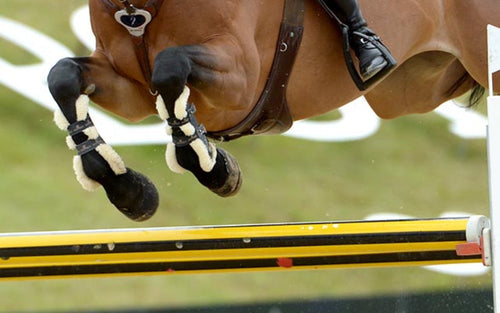
After the forelimbs leave the ground, the shoulder, elbow, carpus and lower limb change position rapidly, bringing the knees upward and folding the distal limb beneath the horse. Good forelimb technique reduces the clearance needed between the horse’s centre of mass and the obstacle. A horse that hangs a foreleg may need more margin — or may touch the fence even when the body itself has travelled high enough.
Meanwhile, the hindlimbs that produced take-off must later flex and pass over the obstacle before extending in preparation for the next canter stride.
5. For a moment, the horse is a projectile — but not a rigid one
There is a useful distinction here. Once airborne, the horse cannot suddenly create another push to change the basic flight path of its centre of mass. Gravity takes over. But the horse can move its head, neck, trunk and limbs relative to one another, controlling orientation and preparing for landing.
Freeze the horse at several points over one fence and it almost looks like several different animals: forelegs folding, neck reaching, back rounding, hindquarters rising, hindlimbs folding — then the whole pattern reversing toward landing.
6. Landing may be the most demanding moment of all
The visual drama of a jump is usually at its highest point. Biomechanically, one of the most important moments comes afterwards.
The forelimbs meet the ground first and must accept a substantial load while forward movement continues. In the force-plate study mentioned earlier, the trailing forelimb experienced the greatest load at landing — in some measurements up to twice the horse’s body weight. Fence height can increase loading, but technique matters enormously too. Research: external limb loads at take-off and landing
Research modelling tendon forces during jump landings has also found very high loading in structures of the lower forelimb, including the superficial digital flexor tendon. This is one reason landing mechanics, conditioning and surface quality matter in jumping horses. Research: forelimb tendon loading during jump landings
High-speed measurements of hoof impact also show that jumping produces impact patterns distinct from ordinary canter, with particularly high accelerations around take-off and substantial forelimb impact at landing. The arena surface is therefore not merely scenery beneath the horse; it is part of the mechanical system. Research: hoof impact in show jumping
7. And the rider? Definitely not just luggage
A good jumping position can look as though the rider simply follows the horse. In reality, horse and rider form one moving system.
Researchers comparing horses jumping loose and with riders found significant differences in several measures of the jump trajectory, including centre-of-gravity position and vertical velocity at take-off. Interestingly, the researchers concluded that much of the rider’s effect appeared to come through changes in the horse’s movement in response to the rider, rather than simply from the rider’s mass being carried over the fence. Research: effects of the rider on jumping kinematics
That makes timing, balance and allowing the horse to use its neck more than matters of style. They influence the movement the horse is trying to organise.
8. Why slow motion changes the way we see jumping
At normal speed, a jump can appear to be one action. In slow motion it becomes a chain of events, each dependent on the previous one.
Watch the last stride. Watch how the forehand meets the ground. Watch the pelvis lower before propulsion. Watch the hind joints extend. Then ignore the fence and watch only the horse’s neck. On the next replay, watch only the forelegs. Then the hindlegs. Finally, watch the landing.
You begin to see that “jumping technique” is not one characteristic. It is coordination across the entire horse.
The extraordinary part is how quickly it all happens
A jumping horse must solve several mechanical problems almost simultaneously: produce enough impulse, choose an efficient trajectory, control rotation, clear the obstacle with its limbs and prepare those limbs to accept the ground again.
And after landing? In competition, there may be another fence only a few strides away.
Perhaps that is what makes a good jump so satisfying to watch. The apparent effortlessness is not the absence of effort. It is the result of strength, anatomy, coordination, experience and timing working together so well that an extraordinarily complex movement looks simple.
#WeShareOurLoveForHorses
Scientific reading: This Story draws on peer-reviewed equine biomechanics research including Schamhardt et al. on limb loading at take-off and landing; Meershoek et al. on forelimb tendon loading; Bobbert and Santamaría on jumping mechanics; and studies of muscle activation, hoof impact and rider effects indexed by PubMed and PubMed Central.